Here are my first impressions of the Modern Goddess Oracle by Ethony and artwork by Elena Semenkova and Sasha Semenkova.
Items Included
49 Goddess Cards; 16 Archetype Cards
A Sturdy Box
A Thick Guide Book
The artwork in this deck is beautiful. It is a modern take on the Goddesses so they are wearing modern clothing with their symbols on their outfits or in the background of the card. The back of the cards are a beautiful royal blue color with a silver symbol on it.
Many Goddesses are included in this deck. Frigg (Frigga is in this deck!)
In the Frigg section, it mentions mistletoe as a symbol of the goddess. The mistletoe was the weapon used to kill her son, Baldr. This symbol for Frigg may not be the best choice.
In the Sekhmet section it mentions that the goddess is associated with menstruation because she is connected to blood. Sekhmet’s association with blood has to do with a myth about Her slaughtering mankind (She got better; humanity was saved). Sekhmet is a goddess of health, surgery, and healing, and she can be called upon to help with issues during menstruation.
In the Isis section, it mentions to watch a TV program or movie that has magic in it as a way to honor the Goddess. As someone who loves Charmed (RIP Shannen Doherty), I thought this idea was awesome.
Final Thoughts
I would highly recommend this deck! The art is gorgeous!
These are my first impressions of The Great Goddess Oracle by Lucy Cavendish and artwork by Jake Baddeley.
Items Included
A sturdy box
42 Cards (with the Triquetra on the back; as a Charmed fan I loved this)
A hefty guide book
What is Different About this Deck
The artwork is beautiful and colorful, but just a word of warning to those who may mind, there is some nudity in this deck. This deck is comprised of 42 cards, but each Goddess has two cards (Card One: Her Blessing; Card Two: Invocation). Within the Guide Book, there is a section which explains how to use the cards and most of them (for your altar; journaling with the cards; meditation; blessing, etc.) is more for communing with a deity then a practical divination method. I would use this deck for more spiritual related questions rather than the mundane, pragmatic ones, then maybe?
The reason I say this is that the entries for the cards in the guide book are all channeled messages (Card One is about the Goddess Herself as if She is speaking to you: the Blessing cards; Card Two is the invocation of the querent who is speaking to the Goddess: the Invocation Cards). These blessings and invocations are beautifully written. They are fantastic.
The sections in the Guidebook on the Goddesses I’m most familiar with were spot on! In the Nephthys section (Yes, Nephthys is in this deck!), the name of a festival is alluded to and mentioned: the Heart of Nephthys Rejoices. This is an obscure festival. The author really did her research. In the Isis section, the author captured Her commanding presence (in my opinion) and Isis as a goddess of the sun, moon, rain, river, magic, and a protective mother. Nut’s section was cosmic. I loved the channeled messages.
What I Loved
I loved the guide book. I liked the art style. I liked the cards. Have I mentioned that Nephthys is in this deck?! (This is the first Goddess Themed deck that I have ever found Nephthys in!). Nephthys is in this deck!
This deck had many Goddesses in it from various pantheons.
Egyptian: Nut, Isis, Nephthys
India: Lakshmi, Kali, Saraswati
Greek: Hekate, Persephone, Demeter
Sumerian: Ninhursag, Ereshkigal, Inanna,
Norse: Hel, Norns, Freyja
Irish: Macha, Babd, Anu
Welsh: Cerridwen, Blodeuwedd, Arianrhod
What May Be an Issue for Some
Many of the Goddesses are bare breasted in this deck (Isis, Nephthys, Nut, Lakshmi, Saraswati, one card of Persephone, Blodeuwedd).
Final Thoughts
I loved the deck. I loved the guide book. I would recommend this deck.
Image of the Box, Guidebook and three cards from the Mystic Oracle: Wisdom of the Ancient Greek Pantheon.
This is a review of the Mythic Oracle: Wisdom of the Ancient Greek Pantheon by Carisa Mellado and artwork by Michele-lee Phelan.
Items Included
Cards
A Guidebook
A sturdy box
The Guidebook
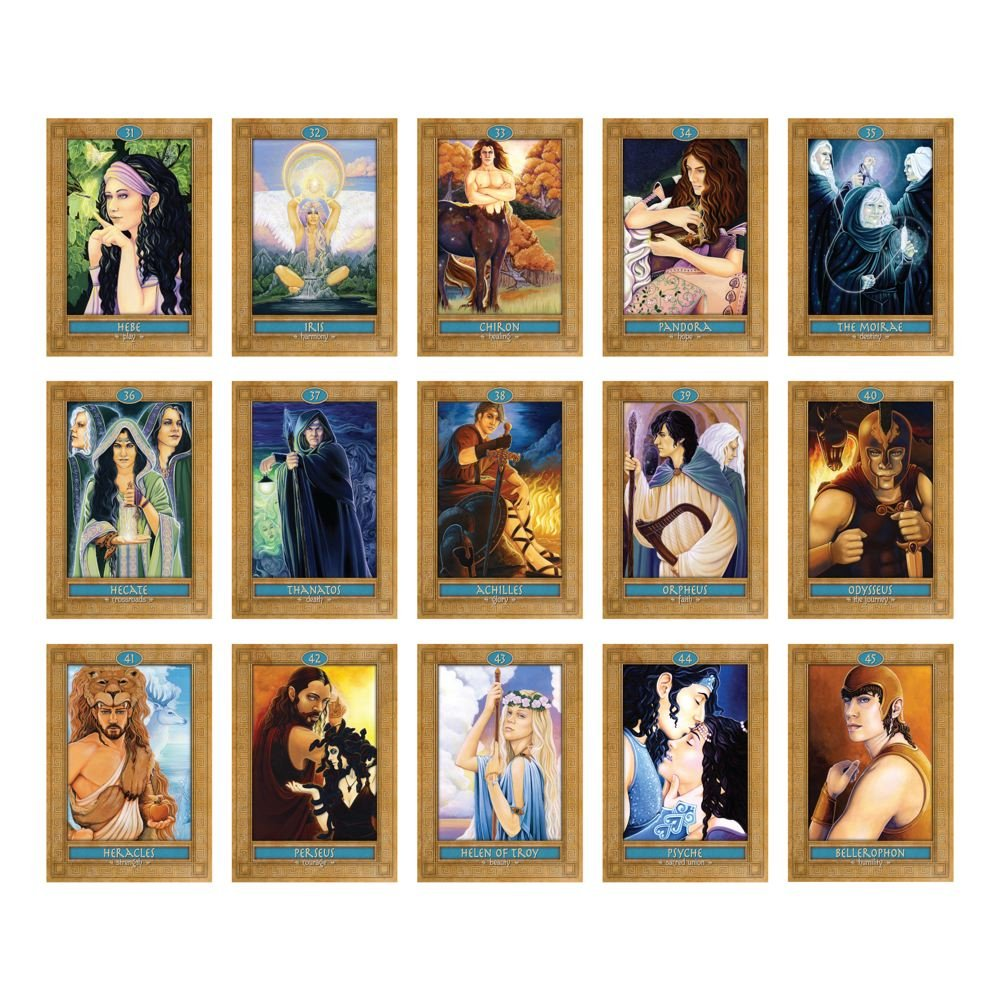
This book has a table of contents and each card is listed with the page number, but the cards are not in alphabetical order. They have sections: Protogenoi (Uranus, Hemera, etc.), Titans (Rhea, Prometheus, Mnemosyne, etc.), Olympians (Hera, Hestia, Athena, Artemis, Apollo, Aphrodite, Persephone, Hades, Hebe, etc.), Magical Beings (Hecate, Pandora, Chiron, The Moirae, Thanatos), and Heroes (Perseus, Psyche, Helen of Troy, Heracles, etc.).
There is an introduction and then there is a section on spreads to use with the Oracle cards. Each page about each card has an image of the card, a small paragraph about each deity and then a message of the card. The messages are longer than in most decks, but they are insightful, useful, and applicable to the querent’s question. Excellently done.
The Cards
Three Rows of the Cards from the Mystic Oracle.
The cardstock is sturdy. The cards are on the larger size so they are slightly hard to shuffle, but maybe that’s just me.
The artwork is beautiful. Athena has her helmet, spear and owl. Hestia is holding a huge hearthfire. Hecate (Hekate) has three forms (two of which look more maiden like and one is elderly. While the image is beautiful, initially Hecate was a maiden (even three formed Hecate were all maidens and only got the older form in the Roman period, iirc). Hades has a dark cloak. Persephone holds a scepter and it looks like she’s in the Underworld as she’s the Queen of the Underworld. Hera is seated on her throne holding peacock feathers.
Three Rows of Oracle Cards from the Mystic Oracle.
The images are wonderful. I highly recommend this deck to anyone who loves Greek Mythology, Greek Gods and Goddesses and Oracle Decks.
The is a review of the Legendary Ladies Goddess Deck by Ann Shen.
Items Included
A sturdy box
58 Colorful Cards
An 80 page guidebook
The Cards
There are 58 cards! Normally Oracle Decks have 44 cards so this deck has over 10 more Goddesses!
This art is beautiful! The cards are so colorful and great! I love the art! I do not like that they have Aset (Isis) as half naked. Her breasts are covered by her hair. Even Aphrodite and Hathor are fully clothed.
The cardstock is sturdy, but the cards themselves are on the larger side. The shuffling technique may need some adjustment for these cards.
The Goddesses included in this deck come from a wide range of traditions and cultures! Here are a few of them included:
Japanese: Amaterasu, Benten
Chinese: Kwan Yin, Chang-O, Hsi Wang Mu, Mazu, Nuwa
Vietnamese: Lieu Hanh
Hindu: Saraswati, Lakshmi, Parvati, Durga, Kali
Egyptian: Aset (Isis), Sekhmet, Hathor, Ma’at, Bast, Nut
Sumerian: Inanna, Atargatis
Norse/Germanic: Freyja, Hel, Ran
Celtic: Brigit, Morrigan, Arianrhod
Greek: Hecate, Athena, Aphrodite, Artemis, Demeter, the Muses
African: Yemoja (Yemaya), Oya, Oshun, Oba, Mami Wata
Mayan: Ixchel
Inuit: Sedna
Polynesian: Hina
Hawai’ian: Pele, Laka
Native American: Estsanatlehi
The Guidebook
It is 80 pages. There is no table of contents.
The art is colorful. On the pages about the cards, all the Goddesses are listed in alphabetical order. The Goddesses’ names are large and colorful so they are easy to find without a table of contents.
Each page about the cards has: the name of the Goddess, a keyword about them (Isis: Strength; Hecate: Magic), their place of Origin (Egyptian, Greek), a sentence about the Goddess, and then a sentence or two about the card meaning. I wish these had been broken up into two paragraphs (so the piece about the Goddess is one paragraph and then the second has the card meaning).
There is a companion book about the myths of each Goddess by Ann Shen: Legendary Ladies: 50 Goddesses to Empower and Inspire You.
I would highly recommend this deck, especially if you love the art style.
Image of the Egyptian Gods Oracle Card Box and a few cards.
I got the Egyptian Gods Oracle Cards by Silvana Alasia (author and artist). I love the ancient Egyptian art that was used in this deck!
Included in the Deck
A Guide Book
A Sturdy Box
36 Oracle Cards
Things I liked
Aset (Isis) has a blue throne headdress. The ancients did that too.
Aset (Isis), Nephthys (Nefhti), Mut, Neith, Seshat, Sobek, Anuket, Satet, Set, Taweret, Serqet (Selkis), Khonsu, Ra, Thoth, Khnum, Ptah, Sekhmet, Nefertem, Amun-Ra, Osiris, Meretseger, Bast (Bastet), Anubis, and Shu were included in this deck! I loved the artwork!
Hathor (Hator) card is on point! She is in a red dress, with Her horns and sundisk headdress! And there is a cow on Her card!
Things I wanted to see included
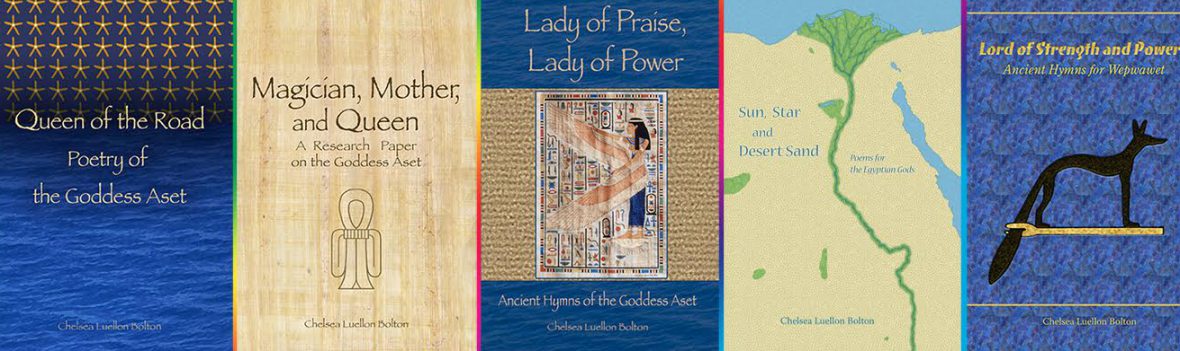
A Wepwawet card! Anubis is included, but not Wepwawet! He needs more love! (I have two books on Wepwawet if anyone is interested: Lord of the Ways and Lord of Strength and Power)!
Shu was included in this deck, but not Tefnut? Why wasn’t Tefnut here? She’s his other half! They are almost always together! (Here is my book on Tefnut with some Shu material: Lady of Water and Flame).
Anubis’s card image is of Him weighing the heart and feather. I wish there was another image for Him. But that’s just personal preference.
The Hathor card has the keyword “intelligence” on it. I think for emotional intelligence, this is spot on! If the author meant book learning intelligence, maybe that would fit Aset (Isis), Djehuty (Tehuti, Thoth) or Seshat more.
The guidebook mentions Set is a god of storms and chaos and also mentions he is evil. (Set is not a god of evil in ancient Egyptian religion. He was demonized later…).
The Aset (Isis) section only mentions Her as the “Mother Goddess” and the ideal wife and mother (She’s a widow and a single mother. How is that ideal?). It does mention She is a goddess of magic though. This was disappointing to see only this mentioned. Aset is a sorceress, a trickster, a scholar, a warrior as an Eye of Ra and so much more.
What was Odd
Some of the names of the Gods and Goddesses are spelled differently even from their Greek names. Nephthys is Nefhti and Hathor was spelled Hator, for example. Maybe this is due to transliterations being different in different languages?
Mut’s card image is off. She is seated and has a vulture headdress only. Where is the rest of Her headdress? She is normally depicted wearing the Double Crown of Upper and Lower Egypt by itself or ontop of the vulture headdress. I’ve never seen Her depicted with just the vulture headdress, but maybe She can be? I don’t know.
Mehen (Ouroboros) is included in the deck. This seemed odd to me.
Ammut is in this deck. She is not a Goddess. She devours the souls of evil doers. She was not honored as a deity by the ancient Egyptians. Why include her in a deck about Egyptian deities?
Apophis (Apep) is in this deck. It is not a Netjer. It is the Entropic Serpent Enemy of the Gods. It is destroyed by Ra, Aset, Set and other gods every day so the sun can rise at dawn. May It be felled! Why would you include this in the deck? This was a horrible choice! It wants to destroy all of creation so that creation never existed. Why include it in an Oracle about Egyptian Gods (and Goddesses)?
Final Thoughts
Overall, I like this deck. The artwork is stunning!
I’m going throw the Apophis card away. So, now the deck has 35 cards instead of the 36 cards in an already shortened deck! (Usually Oracle Decks have 44 cards or more).
The Guidebook is in four languages and the Table of Contents are divided into each language (English, Italian, Espanola and Portuguese) and the cards themselves are not listed in the TOC (and the cards are not in alphabetical order so you have to search to find them). For each card (in the English section), there is the name of the card, a paragraph of who the deity is and the meaning of the card. The meaning of the card is included in the paragraph so it is not easy to spot for a reading. I would have preferred another section for card meanings like they do in most Oracle Card books.
I am disappointed in the guidebook and including the two non-gods in the deck. I love the art though.
This festival commemorates Aset’s nightly search by torchlight for Her husband Wesir. Candles, lamps and torches were lit for the Goddess. Papyrus boats were launched in temple lakes. The boats had prayers written on them with a light source to guide the way.
Ritual for Today
This ritual is what we do for this festival in the House of Netjer.
On Aset’s shrine you could have: an image or statue of the Goddess, a source of light from candles, lamps, LED candles or electric candles and offerings.
You will need paper and a pen or pencil or marker (not red). You will also need a tealight and a lighter.
Write a letter, telling Aset things you are thankful for. Then on the other side, write a letter to Aset asking for things you need. This paper later gets folded into the boat (start folding: thank you side up).
After the paper boats are made, fill a bowl, bathtub or sink with water. A tealight is placed in each boat and they are put in the water. The tealights are lit and the boats float on the water until the candles burn out. (Please keep fire safety in mind).
Thank You/Gratitude Letter Ideas
Family
Friends
Pets
House/Apartment/Condo
Food
Health
Job
Vaccines
Other Things She has helped you with
Ideas of Things You Need
Vaccine for Covid 19
Good Health
Prosperity
Love
Self-Love
Healing
Healing from Grief
Fortitude and Strength
Job
Remember to eat the offerings when you are done. And extinguish the candles.
About Aset
Aset is a goddess of sovereignty, kingship, magic of all kinds, life-power, personal power and authority, writing, words, gaining knowledge, honoring one’s ancestors, ancestral lineage and traditions, dreams, family relationships, self-love, alignment of the souls and healing. She is also a goddess of Heaven, starlight, the night sky and the star Sopdet (Sirius).
I channeled this message from Aset about this festival.
What will you do today for the Fiercely Bright One?
Light candles or lamps? Sing a hymn? Perform ritual before Her shrine? What will you offer to the Lady?
What will you do today for the Mother of God? The one who gave birth to Heru in the Marshes? The sole Mother who took care of Her son?
What will you do for Aset, the Fiercely Bright One? The One who leads the way in the darkness, dispelling shadows with Her light? The stellar and solar goddess of the dawn.
What will you do today? What will you accomplish? What will you profess?
What will you ask Me in your letter? What prayers and hopes will the boats carry on the water, with My light guiding the way?
What will you ask Me to dispel in your lives? What will you ask Me to cultivate?
What will you do for the Fiercely Bright One? What will you ask of the Brightest of Stars? What will you ask of the Solar Goddess?
I am the Mistress of Magic. I am the Goddess Who Knows Her Spells. What I speak comes to pass.
Do not worry, child. I will take care of you.
Who am I? Am I not the Goddess who knows Ra’s Name? Am I not the wisest and cleverest of Gods? Am I not the Goddess of all magic, all heka, all life-power, all kau?
So what will you ask Me on My festival day?
The words you speak and write have power. What I speak comes to pass. What you write is your heart’s desire.
For what you do, what you say and what you write will become.
Dua Nebet Het! Happy Birthday to Nebet Het (Nephthys)! Mother of Yinepu, Sorceress, Sister of Aset, Sister of Set, She Whose Flame is Painful and She Who Wipes Away Tears! Dua Nebet Het!
I got the Sekhmet Servant Oracle Cards by Megan Zane. This deck is wonderful! There are 101 cards in this deck. The images on the cards are watercolor paintings done by Megan Zane with the name of the deities below each image. The card stock is good and stable, but the cards themselves are on the smaller side. They fit in my hand.
The art on this deck is gorgeous! Each image represents an aspect or form of the deity either in traditionally anthropomorphic form, anthropomorphic form with the animal head or in their animal form. Just a note for those who may be confused: Set is represented in this deck with the head of a falcon and the Red Crown. This is historically attested in the Dakhla Oasis during the Roman period in Egypt.
For the Shu card, He is depicted as a lion (and Tefnut’s card has Her as a lioness, which I thought was adorable for the Twins). Also, Anhur (Onuris) is depicted as a man with the feather crown. Anhur is a praise name for Shu. So Shu is technically in this deck twice. Sekhmet also has two cards in this deck (this is Sekhmet’s Servant Oracle, afterall).
Also, Yinepu (Anubis) and Wepwawet are both depicted here in their anthropomorphic form with the jackal head; while Yinepu is black, Wepwawet’s color is dark brown. Wepwawet can be shown in this form with a black jackal head too. I think that having them have different colors helps to tell them apart. Wepwawet is more often depicted as a standing jackal.
For Heru Wer (Horus the Elder) and Heru-sa-Aset (Horus, son of Isis): Heru Wer is in his falcon headed anthropomorphic form with the White Crown and Heru-sa-Aset is depicted in His child form.
Other deities in this deck are ones that are more common (Aset, Nebet Het, Nut, Hethert, Sekhmet, Bast, Yinepu, Geb, Wesir, Serqet, etc) and ones not as common in Egyptian themed Oracle Decks (Sobek, Seshat, Wadjet, Nekhbet, Mut, Sekhmet-Mut, Bast-Mut, Wenut, Taweret, Nehmetawai, Montu, Ptah, Ra, Raet, Nit (Neith), Pakhet, Repyt, Shu, Tefnut, Wepwawet, Menhit, Iusaas, Khnum, Anukis). There are groups of deities or spirits included too (7 Hetherts, 4 sons of Heru, etc).
What I loved: the cards and art are amazing! There are so many gods and goddesses in this deck! I am so happy that Wepwawet, Mut, Bast-Mut and Sekhmet-Mut finally get a spot in an Oracle Deck!
Things to Consider: This deck is independently published via print on demand. For only the cards, it is $38 plus shipping. There is a companion book which is sold separately for approximately $13. There is no box or small booklet. I put my deck in a tarot bag.
Overall: I would definitely recommend this deck to someone who honors ancient Egyptian Gods (especially the more obscure ones)! I would recommend this for diviners as well with a caveat that you may want to know or read about these gods before doing a reading with this deck.
This review was just for the cards as I don’t yet have the companion booklet.




 Fiercely Bright One