Epithets Series, Goddesses, Nut, Nuit, Uncategorized

Epithets of Nut

Epithets of Nut

  • At Whose Feet is Eternity
  • Brilliant One
  • Coffin
  • Coverer of Heaven
  • Daughter
  • Daughter of Shu
  • Dominates the Northern Sky
  • Effective One
  • Established One of Geb
  • Eye of Ra
  • Female Pig Who Eats Her Piglets
  • Goddess of the Sycamore Tree
  • Grand Horizon
  • Great
  • Great Being Who is in the World of the Dead
  • Great Divine Beloved Soul
  • Great Ihet-Cow Who Brings Ra into the Day
  • Great Lady
  • Great, Mother of God
  • Great One
  • Great Princess at the Birthplace
  • Great, Who Gave Birth to the Gods
  • Great Wild Cow
  • Heavenly Cow
  • In Whose Hand is the Always
  • Lady of Heaven
  • Lady of the Sycamore
  • Land of Your West
  • Lofty One
  • Mighty Goddess in the Womb of Your Mother Tefnut
  • Mighty One in Your Mother
  • Mistress of Big
  • Mistress of Heaven/the Sky
  • Mistress Over the Earth
  • Mother
  • Mother of All the Gods
  • Mother of God
  • Mother of God of the Gods and Goddesses
  • Mother of Heaven
  • Mother of Set
  • Mother of the Gods
  • Mother of the Stars
  • Mysterious One
  • One with a Thousand Souls
  • One Who Hears
  • Perfect Daughter
  • Powerful from Her Mother
  • Queen of All Gods and Goddesses
  • Sarcophagus
  • Scepter of the Sky
  • Sepulcher
  • She Who Bore the Gods
  • She Who Comes Out of the Arms of Aker
  • She Who Extends Her Arms
  • She Who Gives Birth to the Gods
  • She Who Gives Birth to Ra Everyday
  • Sky
  • Soul of the Brilliant One
  • Sovereign of All the Gods
  • She of the Braided Hair Who Bore the Gods
  • The Great
  • The Mighty
  • Uniter of the Two Lands of Geb
  • Uraeus Serpent
  • Veil of Heaven
  • Venerable One
  • Venerable and Powerful
  • Venerable in the Shrine-of-the-Venerable
  • Who Bore the Gods
  • Who Came into Being in the Sky
  • Who Counts the Days
  • Who Does Fill Every Place with Her Beauty
  • Who Gave Birth to the Gods
  • Who Gives Birth to the Gods
  • Who Gives Birth to the Rulers of the Country
  • Who Has Given Birth to All the Gods
  • Who is Crowned like the King of the North
  • Who is Mighty
  • Who is in the Mysterious Abyss
  • Who Protects the Son of Wesir
  • Who Rose in Splendor as the Bee
  • Who Shelters Him (Heru)
  • Who Spreadest Over Me
  • Whose Adornments are Among the Goddesses
  • You are Above Your Father Shu
  • You Have Encompassed the Earth, Everything is in Your Two Hands
  • You have United the Earth in Every Place

Sources

  • Baring, Anne and Jules Cashford. “Isis of Egypt: Queen of Heaven, Earth and the Underworld,” in The Myth of the Goddess: Evolution of an Image. Anne Baring and Jules Cashford, ed. New York: Penguin, 1993, pp. 225-272.
  • Budge, E. A. Wallis. An Introduction to Ancient Egyptian Literature.  (Dover Publications, 1997), 18-19.   Reprint of Budge’s work from 1914.
  • Brier, Bob. Ancient Egyptian Magic. New York: William Morrow and Company, 1980.
  • Cauville, Sylvie. Dendara XV: Traduction: Pronaos de Temple d’Hathor. Peeters, 2012.
  • Cauville, Sylvie. La Temple de Dendara: La Porte d’Isis. Institut Francais d’Archeologie Orientale, 1999.
  • Cauville, Sylvie. Dendara: Le Temple de Isis. Vol 1. Traduction. Orientalia Lovaniensia Analecta, Peeters, 2009.
  • David, Rosalie. Religion and Magic in Ancient Egypt. Penguin Books, 2003. p. 348.
  • El-Sabban, Sherif. Temple Festival Calendars of Ancient Egypt. Wiltshire: Liverpool University Press, 2000.
  • Foster, John. Hymns, Prayers and Songs: An Anthology of Ancient Egyptian Lyric Poetry. Scholars Press, 1995.
  • Hornung, Erik. Conceptions of God in Ancient Egypt: the One and the Many. Translated by John Baines. Ithaca: Cornell University Press, 1996.
  • Junker, Hermann. Der Grosse Pylon des Tempels der Isis in Phila. Wien: Kommission bei Rudolf M. Rohrer, 1958.
  • Junker, Hermann and Erich Winter. Das Geburtshaus des Tempels der Isis in Phila. Wien: Kommissionsverlag H. Böhlaus Nachf., 1965.
  • Lesko, Barbara. The Great Goddesses of Egypt. Oklahoma: University of Oklahoma Press, 1999.
  • Lesko, Leonard H. “Nut.” in Ancient Gods Speak: A Guide to Egyptian Religion.  Oxford University Press, 2002, 277-278.
  • Nicoll, Kiya. The Traveller’s Guide to the Duat. Megalithica Books, 2012.
  • Parker, Richard. The Calendars of Ancient Egypt. (The Oriental Institute of the University of Chicago. Studies in ancient oriental civilization). University of Chicago Press, 1950.
  • Piankoff, Alexandre. Mythological Papyri: Bollingen III Series. University of Princeton Press, 1957.
  • Piankoff, Alexandre. The Shrines of Tut-Ankh-Amun: Bollingen II. University of Princeton Press, 1955.
  • Piankoff, Alexandre. Tomb of Ramesses VI: Bollingen I. University of Princeton Press, 1954.
  • Pinch, Geraldine. Magic in Ancient Egypt. Austin: University of Texas Press, 1995.
  • Pinch, Geraldine. Egyptian Mythology: A Guide to the Gods, Goddesses and Traditions of Ancient Egypt. New York: Oxford University Press, 2004.
  • Pinch, Geraldine. “Offerings to Hathor,” Folklore Vol. 93, No. 2. (1982), pp. 138-150.
  • Roberts, Alison. Hathor Rising: The Power of the Goddess in Ancient Egypt. Vermont: Inner Traditions International, 1997.
  • Roberts, Alison. My Heart My Mother: Death and Rebirth in Ancient Egypt. England: Northgate Publishers, 2000.
  • Roberts, Alison. Goddess Shrine, Goddess Queen: Egypt’s Anointing Mysteries. Northgate Publishers, 2008.
  • Siuda-Legan, Tamara. The Neteru of Kemet. Eschaton Productions, 1994.
  • Siuda, Tamara. Nebt-Het: Lady of the House. Illinois: Stargazer Design, 2010.
  • Siuda, Tamara. The Ancient Egyptian Prayerbook. Illinois: Stargazer Design, 2009.
  • Wells, R. A. “The Mythology of Nut and the Birth of Ra,” in Studien zur Altägyptischen Kultur. 19 (1992), pp. 305-321.
  • Wilkinson, Richard H. The Complete Gods and Goddesses of Ancient Egypt. New York: Thames and Hudson, 2003.
  • Wilkinson, Richard H. The Complete Temples of Ancient Egypt. New York: Thames and Hudson, 2000.
  • Wilkinson, Richard H. Reading Egyptian Art. New York: Thames and Hudson, 1992.
  • Wilkinson, Richard H. Symbol and Magic in Egyptian Art. New York: Thames and Hudson, 1994.
Set, Seth

Dua Set and Walk Forth in Strength

by Jeff Dahl
by Jeff Dahl

Today is Set’s Birthday on the Kemetic Orthodox Calendar.

I have lit His candle and said his prayer as I did for Wesir and Heru Wer the two days prior.

Saryt, a talented musician, singer, and sculptor has written and sang two songs dedicated to Set.  I would like to share them with you on His birthday.

Dua Set by Catfolk

http://catfolk.org/track/dua-set

Walk Forth in Strength by Catfolk

http://catfolk.org/track/walk-forth-in-strength

Dua Set!  Happy Birthday to the Red Lord!

Articles, Aset Luminous, Auset Luminous, Isis Luminous, Aset Neferset, Auset Neferset, Isis Nepherses, Aset of Pharos Lighthouse, Auset of Pharos Lighthouse, Isis Pharia, Aset, Auset, Isis, Aset-Serqet, Auset-Serqet, Isis-Selkis, Bright Week

Bright Week: Aspects of Aset; Aset vs. Isis

Aspects of Aset and Aset vs. Isis
by TahekerutAset

Aset is a multi-faceted Goddess who worship spanned for thousands of years with ancient Egyptians, Nubians, Greek and Romans all honoring Her in some way.
For the most part, Her ancient Egyptian attributes are as the mother and maker of kings, the Mother of Heru and the Goddess of the Throne, its sovereignty and lineage. Continue reading “Bright Week: Aspects of Aset; Aset vs. Isis”

Articles, Aset Luminous, Auset Luminous, Isis Luminous, Aset Neferset, Auset Neferset, Isis Nepherses, Aset of Pharos Lighthouse, Auset of Pharos Lighthouse, Isis Pharia, Aset, Auset, Isis, Aset-Serqet, Auset-Serqet, Isis-Selkis, Bright Week

Bright Week: Aset, Possessor of Strength

Aset, the Possessor of Strength

Aset is the Strongest of Goddesses as She is the one along with Set to destroy Ap-p during Ra’s Nightly Journey. In one myth, She stopped the Sun Boat to heal Heru-sa-Aset.

She mourned and worked through Her anguish when Wesir died and raised Her son as a single mother.

She is depicted wielding a scimitar, slaughtering the enemies of Her son or husband or Her Father Ra with flame.

At Aswan and Philae temples, Aset is called “Chief at the Head of the Army” and “Possessor of Strength”. She has a very bellicose nature here as these temples were positioned at country borders where enemies could invade.

Q&A Session

When have you asked Aset for strength? Who is Aset as a Goddess of strength and fortitude? How do you see Aset as a possessor of strength?

Aset Luminous, Auset Luminous, Isis Luminous, Aset Neferset, Auset Neferset, Isis Nepherses, Aset of Pharos Lighthouse, Auset of Pharos Lighthouse, Isis Pharia, Aset, Auset, Isis, Aset-Serqet, Auset-Serqet, Isis-Selkis, Bright Week

Bright Week: Aset and Her Family

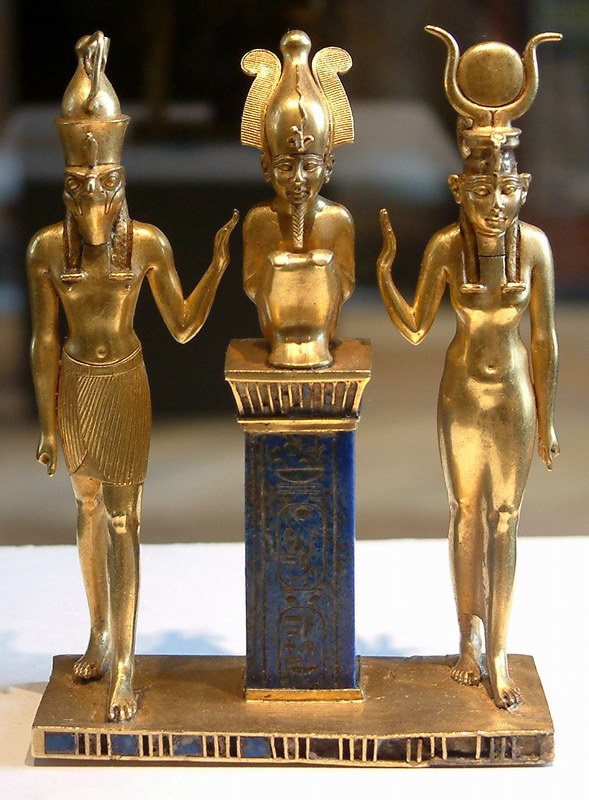
Egypte_louvre_066

Aset and Her Family

Throughout the ancient Egyptian history, Aset has been connected with many deities as Her family members. First off, Her parents are the sun God Ra or the Earth God Geb and the Sky Goddess, Nut. In one instance Tefnut is said to be Her Mother. Her siblings are Nebet Het, Wesir, Heru Wer and Set.

In most of Her mythology and cult centers, Wesir is Her Husband. She mourns him and searches for Him when he passes away. She then conceives Her son Heru-sa-Aset through Wesir’s lightning or the golden phallus.

She raises Heru-sa-Aset alone in the marshes and heals him from various ailments and protects Him from danger. She aids Him in his trial for Kingship. When He wins, She places the new King on His throne.

In other cult centers and time periods, Aset is the mother of Wepwawet, Sobek, or Min (with Wesir as the Father). Wepwawet, Min or Sobek can also be consorts. Sometimes they are even syncretized with Wesir (at least in Sobek and Min’s case). Sometimes Yinepu is mentioned as Her son.

Aset can be the Mother, Daughter or Consort of Ra.

For my essay on this, with citations go here: Aset’s Family

Q&A Session

Do you honor Aset alongside one of Her family members? If so, what have your experiences been?

Aset Luminous, Auset Luminous, Isis Luminous, Aset Neferset, Auset Neferset, Isis Nepherses, Aset of Pharos Lighthouse, Auset of Pharos Lighthouse, Isis Pharia, Aset, Auset, Isis, Aset-Serqet, Auset-Serqet, Isis-Selkis, Bright Week

Bright Week: Aset, the Fiercely Bright One

candles
“Candles”. Licensed under Public Domain via Wikimedia Commons

Aset, the Fiercely Bright One

Aset is a stellar and solar Goddess. Aset is an a daughter of Ra, an Eye of Ra and She can manifest as a lioness, cobra or leopard in this form.

She is a Sovereign of the Sun Disk and a Goddess of Dawn and Dusk.
She is the Goddess who guides the Sun Boat and destroys the Uncreated with Her magic. She is a fierce protector who destroys enemies with flame.

As Sopdet, She brings the New Year, appearing in the Sky when the Nile flooded the land. Sopdet is the brightest star in the sky apart from the sun.
She is the Lady of Stars and is a Goddess of the Starry Heavens.

In various myths, she is also the daughter, consort or mother of Ra.

Q&A Session
Continue reading “Bright Week: Aset, the Fiercely Bright One”

Articles, Aset Luminous, Auset Luminous, Isis Luminous, Aset Neferset, Auset Neferset, Isis Nepherses, Aset of Pharos Lighthouse, Auset of Pharos Lighthouse, Isis Pharia, Aset, Auset, Isis, Aset-Serqet, Auset-Serqet, Isis-Selkis, Bright Week, Festivals

Bright Week: A Week for Aset

Bright Week: A Week Long Celebration of the Goddess Aset

Bright Week is a week-long celebration for the ancient Egyptian Goddess Aset! We are celebrating this within the House of Netjer during this week (June 24-30) with chats, rituals, lighting candles, forum topic posts and giving Her plenty of offerings!

Continue reading “Bright Week: A Week for Aset”

Aset Luminous, Auset Luminous, Isis Luminous, Aset, Auset, Isis, Calendar, Festivals, Kiya Nicoll

Brightest of Light

Kiya Nicoll, author of The Traveller’s Guide to the Duat: Amenti on Two Deben a Week
wrote a blog post about the calculation of calendars and the position of Sopdet.

The post is here: I Love it when a plan comes together

What she found out was that the date where the sun and Sopdet are closest? Aset Luminous.

If anyone is interested, here are links to Kiya’s book:

From Megalithica Books: Traveller’s Guide to the Duat

From Amazon (Paperback): Traveller’s Guide to the Duat

Ebook: Traveller’s Guide to the Duat

Aset, Auset, Isis, Books, Calendar, Kiya Nicoll, Links, Musings

Aset’s Yearly Cycle

Kiya Nicoll, author of The Traveller’s Guide to the Duat: Amenti on Two Deben a Week, wrote a post on her blog which inspired the musings below: Calendric Rhythms

After reading her post, I had these thoughts about Aset’s Yearly Cycle. So here are my musings.

And now I’m thinking of my own Aset Yearly Post where Akhet is Her in Mourning and Change (Transformation is a type of change). I am also reminded that Her Marriage Festival and the Mysteries are right next to each other. Peret is where Aset and Heru avenge Wesir and Heru is established at King. Aset here is the King-Maker and Avenging Goddess. Shomu are the months of the Heat of the Eye of Ra, the solar and stellar brightness permeate all of creation from both the Seen and Unseen realms (Aset has a lot of fire festivals here both solar and stellar ones). And the Days Upon the Year bring renewal, dissolution of the old and rebirth for Aset is born on Her Day and on New Year’s as the Star Sopdet bringing the power of the flood to being again.

Thank you for such a great post! I’m having thoughts!

Here are links to Kiya Nicoll’s book.

From Megalithica Books: Traveller’s Guide to the Duat

From Amazon (Paperback): Traveller’s Guide to the Duat

Ebook: Traveller’s Guide to the Duat